
What Are the Standard Sizes for Double-Ended Stud Bolts?
Double-ended studs are headless fasteners with threads on both ends, featuring easy disassembly and stable connection performance, and are widely applied in mechanical equipment, pipeline engineering, flange connection and other industrial assembly scenarios. Accurate matching of standard dimensions is the core premise to ensure assembly accuracy and operational safety of equipment. The most widely used international reference specifications for double-ended studs adopt Chinese National Standard (GB/T) systems, which cover mainstream conventional and high-strength models for global industrial procurement.
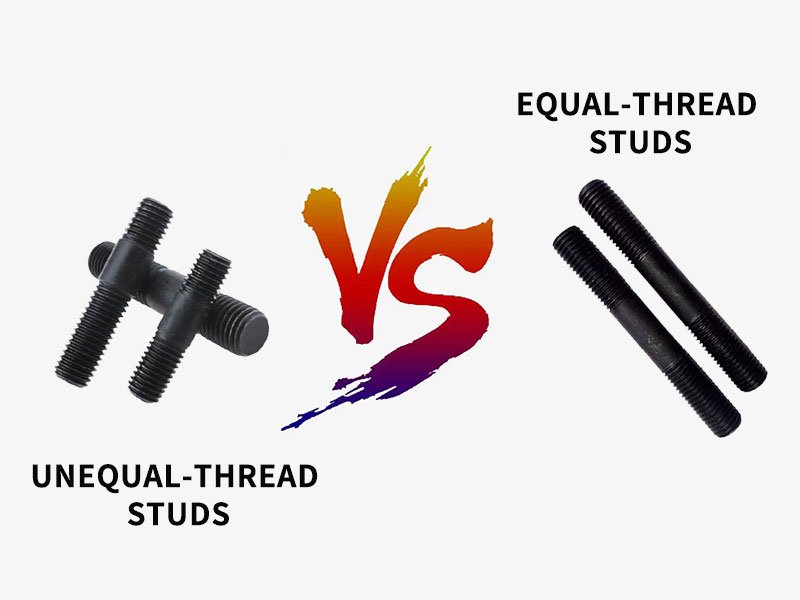
GB/T standard double-ended studs are mainly divided into two types: unequal-thread and equal-thread studs. Unequal-thread double-ended studs comply with GB/T 898 and GB/T 899 standards. With different thread lengths at both ends, they are designed for one end to screw into the base thread hole and the other end to fasten with a nut, ideal for equipment shell fixing, flange connection and other conventional assembly scenarios. Their common thread specifications range from M5 to M48, with standard thread end lengths matched to corresponding diameters, and the standard nominal length covers 30mm to 200mm, meeting most general industrial assembly demands worldwide.
Equal-thread double-ended studs follow the GB/T 901 standard, with identical thread lengths at both ends and uniform overall stress resistance, making them suitable for high-strength and high-vibration working conditions. This series boasts a comprehensive specification range: standard sizes cover M8 to M36, while customized sizes extend from M4 to M72. The nominal length ranges from 20mm short-size to 500mm long-size standard products, serving as the most versatile fastener type in global mechanical supporting applications.
GB/T standard double-ended studs adopt unified marking specifications for global procurement reference. The standard marking format is “Standard No. + Thread Specification × Nominal Length”. For example, GB/T 901 M12×100 refers to an equal-thread double-ended stud with a 12mm thread diameter and 100mm overall length. It is necessary to distinguish thread pitch during selection: coarse thread studs adopt standard default pitch, while fine thread studs require explicit pitch marking to avoid specification mismatch and assembly errors.
Procurement and selection of GB/T standard double-ended studs need to comprehensively consider dimensional parameters and application adaptability. 4.8-grade carbon steel standard sizes are applicable for light-duty mechanical equipment, while 8.8-grade and above high-strength standard specifications are recommended for heavy-duty equipment and high-pressure pipeline systems. Buyers shall match the thread length and overall nominal length according to actual assembly space, effectively preventing assembly looseness, stress failure and other equipment failures caused by inappropriate dimensions.


